
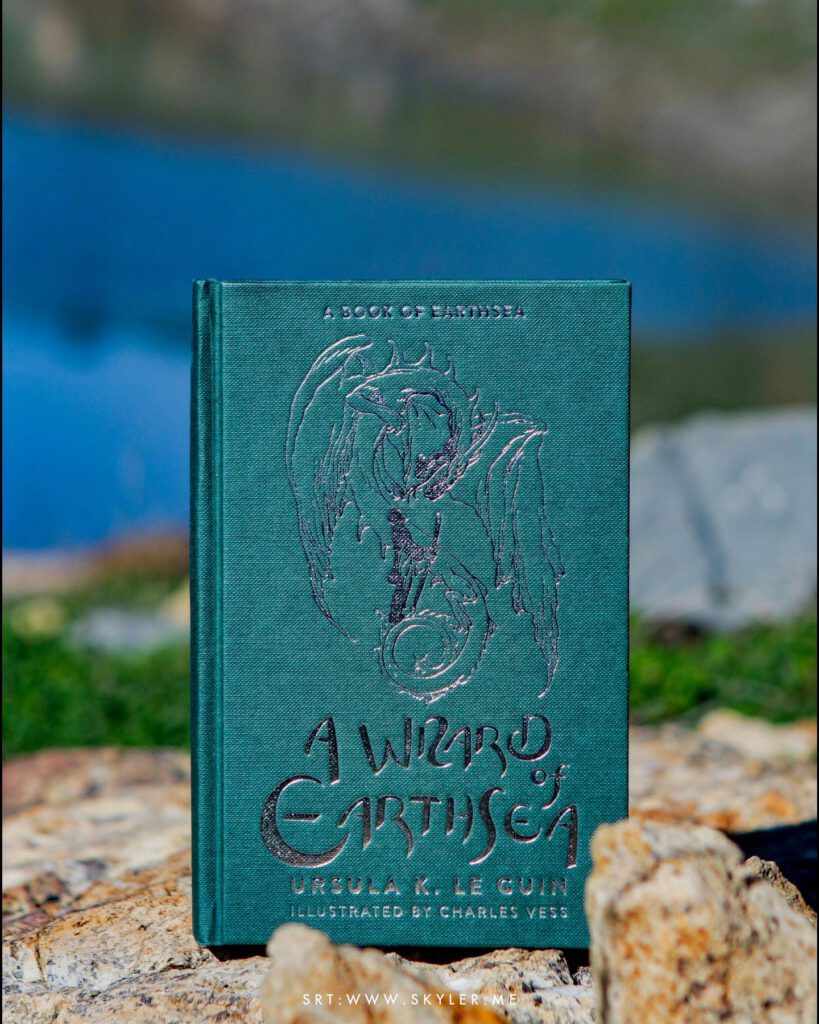
“The island of Gont, a single mountain that lifts its peak a mile above the storm-racked Northeast Sea, is a land famous for wizards.”
Ursula K. Le Guin, A Wizard of Earthsea, 1968
///
I have thoroughly enjoyed at long last visiting Earthsea.
Le Guin’s world of islands and ocean has had far more influence on the development of the fantasy genre than I realized. Wizards are present, but in a way that still feels fresh and new.
This is a hero’s journey, to be sure. Sparrowhawk is our young hero, full of power and hubris and pettiness, and with much to learn. He is sent to a school for wizards but, instead of playing quidditch and having laughs in Gryffindor Tower, he gives in to his small grievances and lets loose an unspeakable evil into the world.
And unspeakable has a different meaning in the world of Earthsea.
The mythology of this world references the beginning of time, when all things were given their original, true names. Though these names have been lost to time, it is the job of wizards to learn them, and pass them down. By knowing the true names of things, like the wind, the seas, even animals and other people, you can gain power over them. The code of wizards teaches this power should be used for good, but our young Sparrowhawk is too proud for the lesson.
And so he must set out, to either hunt or be hunted, by the shadow he has released into the world. A thing which knows Sparrowhawk’s true name but seems to have no name itself.
In the process, Sparrowhawk will learn, as J.K. Rowling would summarize so well in her books about another young wizard 30 years later, that, “Fear of a name increases fear of the thing itself.”