

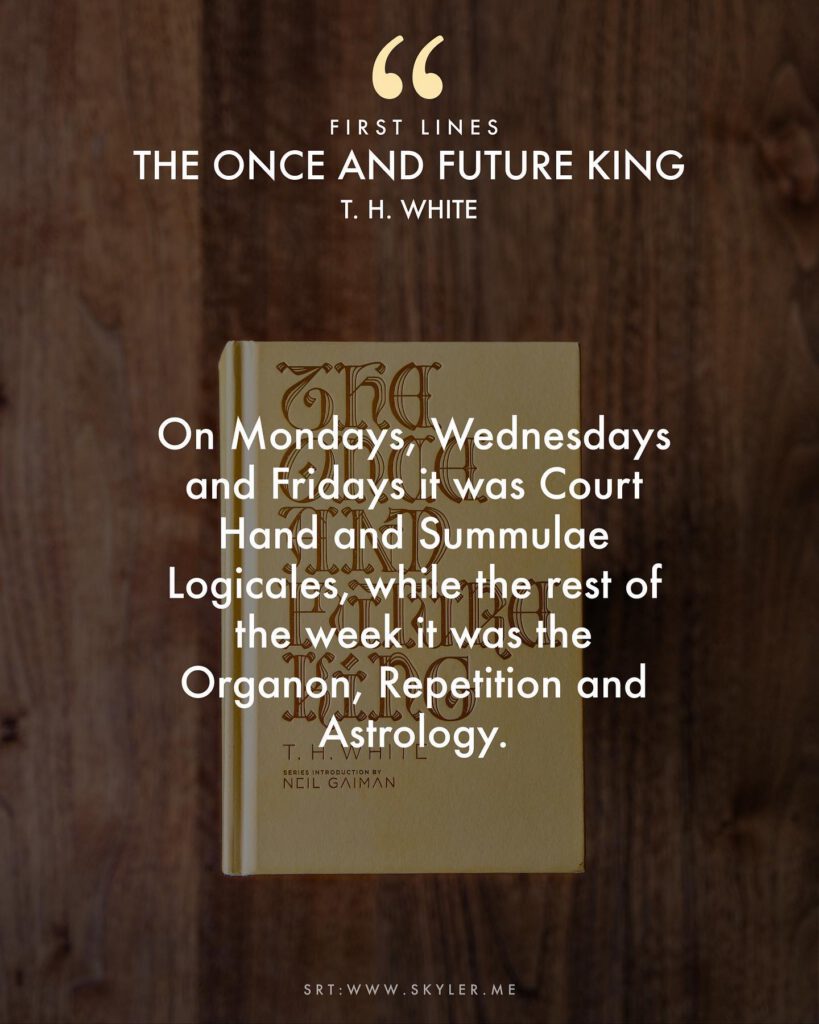
“On Mondays, Wednesdays and Fridays it was Court Hand and Summulae Logicales, while the rest of the week it was the Organon, Repetition and Astrology.”
T. H. White, The Once and Future King, 1939, 1940, 1958
///
Many are familiar with the first portion of this retelling of the legend of King Arthur — The Sword in the Stone was adapted into an animated Disney film of the same name. The tone of that film is more or less the same as the first portion of the book. The book becomes less whimsical as it goes along.
Central to the story is the ancient feud between Gaels and Gauls. The clan from Orkney, led by headstrong Gawain, represent the Highlands, the Old Ways, the Gaelic people. They have a tentative peace with the Gauls, the usurpers from France whom Arthur represents. Through incestuous treachery Arthur is seduced and has a son, Mordred, brother to Gawain, who is the anti-Arthur, bent on tearing apart all that Arthur has stitched together.
Another throughline is the life-long love affair between Sir Lancelot, greatest of all knights, and Queen Guenever. For decades Arthur’s loves for both Guenever and Lancelot, and both lovers’ supreme admiration for Arthur, allows their open secret to exist in an uncomfortable triangle. Eventually Arthur’s invention of common law, weaponized by treacherous Mordred, demands justice against Guenever and Lancelot for their treason against the crown.
The Candle in the Wind is the final part of The Once and Future King, in which it seems all that Arthur has built will be snuffed out. Ultimately the book doesn’t answer the question of how the civil war between the king and Mordred ends, dealing instead with Arthur’s lasting legacy of justice over strength.
On the eve of his last battle, in the last pages of the book, Arthur tells a young page to return to his village to tell his story rather than die futilely.
“I am giving you the candle now—you won’t let it out?”
“It will burn” comes the page’s reply as he passes the story on to us.